
Feedback from the AFEN × Herbert Smith Freehills Kramer event on June 10, 2026
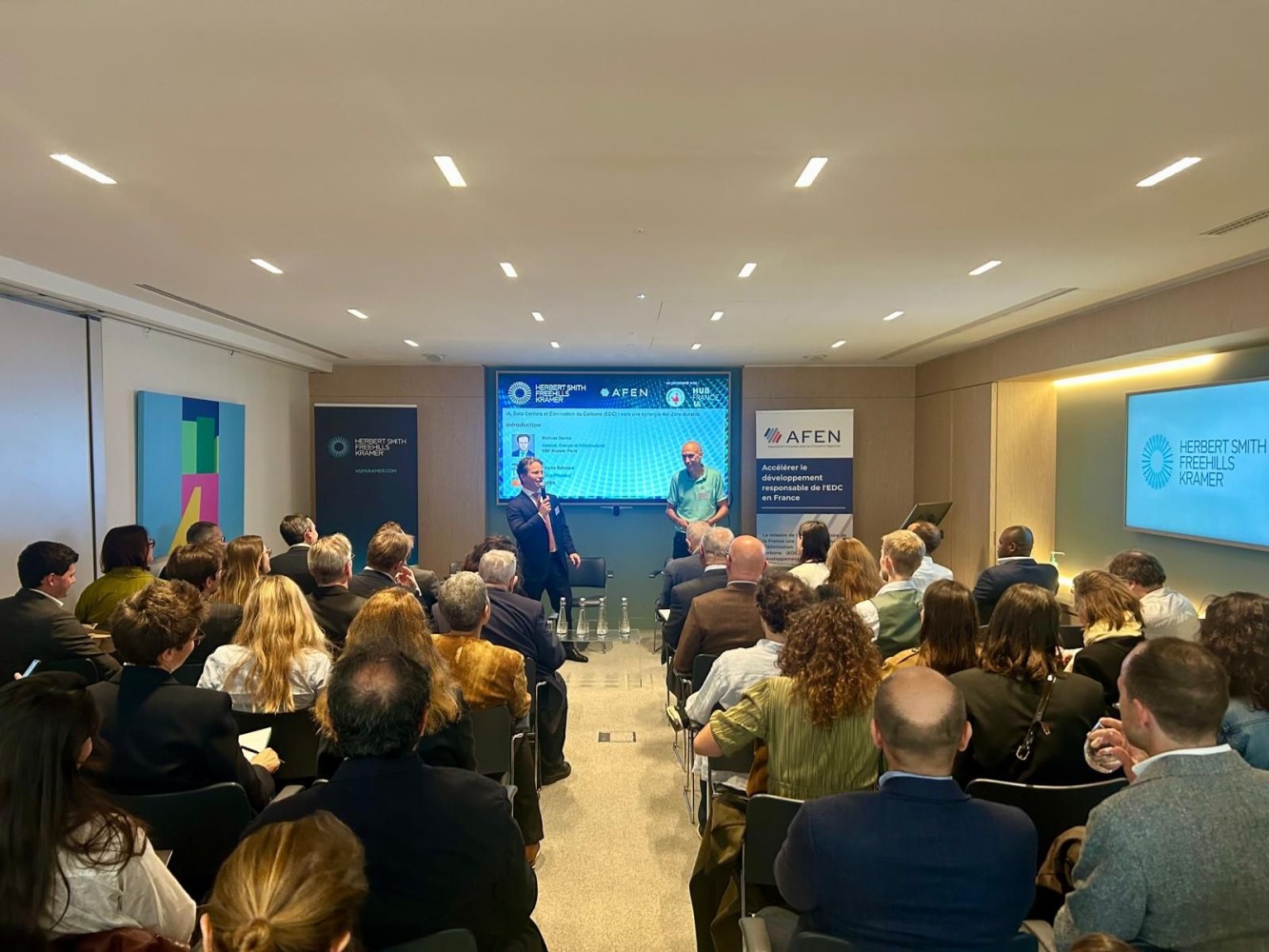
Guiding the AI revolution—and the accompanying expansion of data centers—toward true neutrality. That was the focus of the strategic meeting organized on June 10 by AFEN and Herbert Smith Freehills Kramer.
The global carbon footprint of data centers is rising in tandem with AI: 180 million metric tons of CO₂ today, with 300 to 500 expected by 2035, according to the IEA. A growing share of these emissions—known as «embodied carbon,» which is linked to materials and construction and accounted for under Scope 3—will not decrease by then. It is therefore not surprising that tech giants—led by the United States—have become the main drivers of the global carbon removal (EDC) market in recent years.
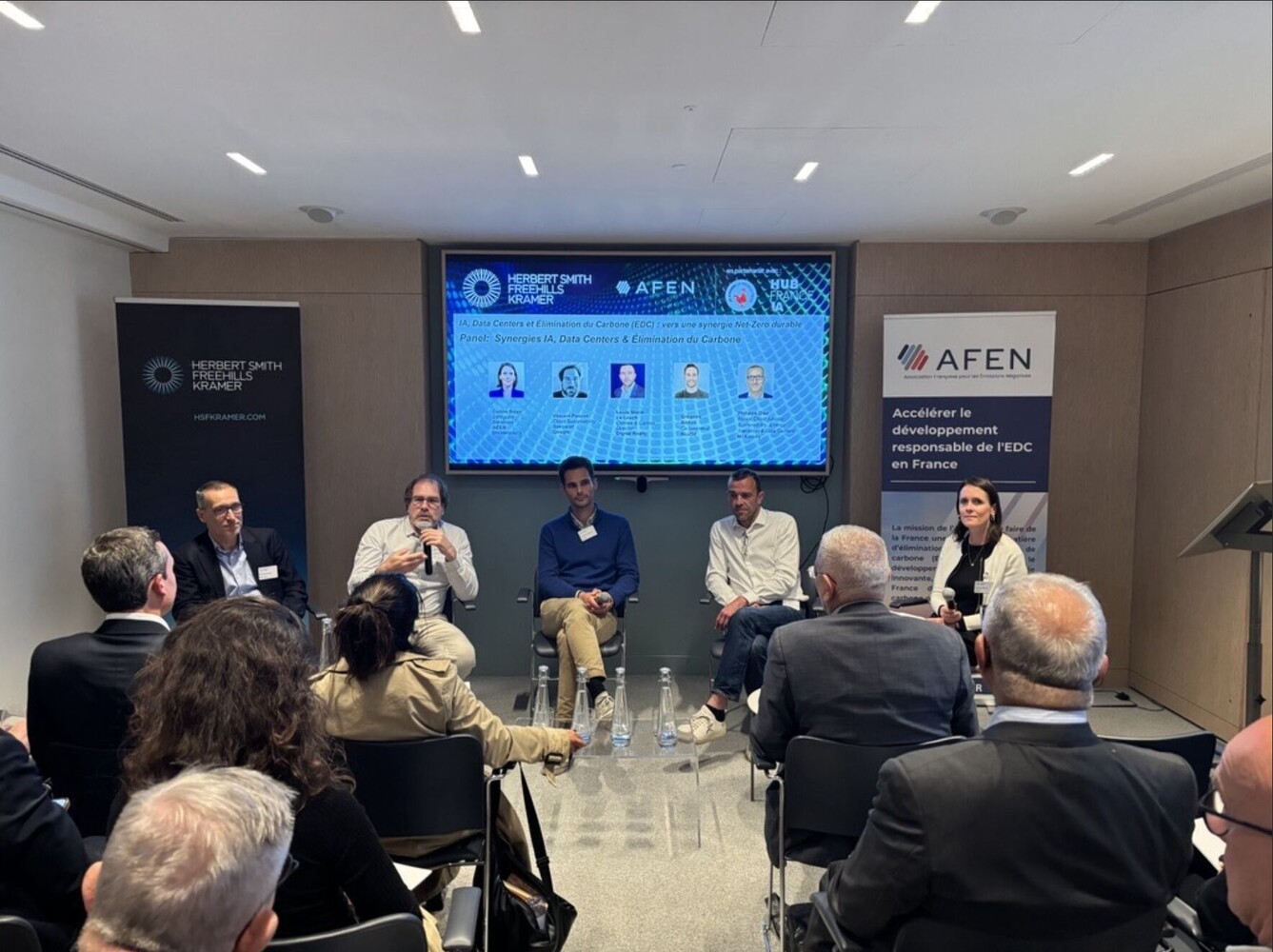
It was against this backdrop that the event brought together technology leaders, infrastructure providers, investors, and major companies, including Mathias Dantin (Herbert Smith Freehills Kramer), Karim Rahmani (AFEN), Ana Semedo (Hub France IA), Léo Barruol and Marc Halgand (SE Advisory Services), Louis-Marie Le Leuch (Digital Realty), Grégoire Alston (Resoil), Vincent Poncet (Google Cloud), and Philippe Diez (McKinsey).
One question guided the discussion: How can the AI and EDC sectors move forward together and support one another? And how can the French EDC sector transform this digital ecosystem into a more virtuous model? For the EDC ecosystem, the answer points to a new opportunity—provided it is developed correctly.
Energy Efficiency Has Reached a Plateau
A data center, like any other organization, must first reduce its overall environmental footprint. This requires low-carbon electricity and increased energy efficiency. Regarding the latter, major operators are already approaching the physical limit: the PUE (Power Usage Effectiveness, or energy efficiency indicator, which measures the ratio of total energy consumed to the energy actually used to power servers) of hyperscalers is around 1.2 (very efficient), while the industry average has stagnated around 1.4 for the past decade. Efficiency gains are plateauing and will become marginal: this lever alone will not be enough to further reduce emissions.
«Embedded» carbon in Scope 3
However, the PUE measures only the efficiency of the facility. It says nothing about embodied carbon or Scope 3 emissions, which fall under its purview.
In carbon accounting, Scope 3 encompasses indirect emissions across the entire value chain, beyond direct emissions from the facility (Scope 1) and purchased electricity (Scope 2). For a data center, this includes embodied carbon: the carbon emitted to produce steel, concrete, servers, and components, even before the facility goes into operation. These emissions are fixed once the infrastructure is built; no energy efficiency measures will reduce them.
They must therefore be addressed upstream, in collaboration with suppliers, particularly through the use of low-carbon materials. The EDC then steps in to address residual emissions, complementing—but never replacing—robust and ambitious decarbonization efforts.
The EDC does not exempt us from decarbonization. Reducing and eliminating: both must accelerate simultaneously—and this applies to data centers as well. This is a point on which all speakers agreed. A data center, like any other organization, must first reduce its overall carbon footprint.
Regulatory signals are also pointing in this direction. Version 2.0 of the SBTi standard, published in June, makes carbon elimination a mandatory requirement for large companies, which will be required to offset 1 % of their residual emissions by 2035, followed by an increasing share up to 100 % by the net-zero target—fifteen years earlier than in the previous version. Tech giants and data center operators—many of whom have already made net-zero commitments—are among the first to be affected. For them, the EDC is shifting from a voluntary choice to a time-bound requirement.
Buying early means securing tomorrow's availability
Tech giants are already the driving force behind the global EDC market. Their purchasing strategy offers valuable insights for the EDC sector: securing a supply of high-quality credit today, building resilience into their value chains, and contributing to the development of this still-young industry to help drive down costs.
However, the market must still be able to absorb this demand. EDC transactions currently rely on custom contracts that are time-consuming and costly to negotiate. This is a real obstacle for emerging projects. The standardization efforts presented by Mathias Dantin (Herbert Smith Freehills Kramer), centered on the OSCAR open-ended model contract, aim to remove this obstacle: a common framework for risk allocation, delivery, and monitoring (MRV) that shortens sales cycles and makes transactions more easily replicable.
The Strength of the French Industry: Its Geography
France, for its part, has a major advantage: its carbon-free, abundant, and competitive electricity attracts projects, with 18 GW of capacity already announced. This appeal transforms a global trend into a local opportunity. It also raises real questions: conflicts over land use, water, and wait times for grid connections.
This is where our ecosystem has a role to play. Demand from data centers can be met through local EDC projects, as close as possible to the sites. «A data center isn’t just about connecting to a power source,» noted Ana Semedo (Hub France IA).
The example presented by Digital Realty and Resoil illustrates this point. Rather than offsetting its residual emissions solely through credits purchased from distant sources, a data center operator invests in local projects—in this case, regenerative agriculture certified as low-carbon. The benefits are tangible: additional income for farmers, soil restoration, and a stronger local presence.
This last point is crucial. A data center involves very real challenges—land, water, and access to the power grid—and approval for such projects increasingly depends on acceptance by local communities and nearby residents. For AI projects, partnering with EDC initiatives that deliver economic and environmental benefits to the local area thus becomes both a key factor in gaining acceptance and a step toward addressing climate change. Our EDC Territorial Mapping confirms that France’s potential is not uniform; it is a mosaic, often concentrated in rural areas, close to resources. Bringing digital demand and local projects together means aligning two dynamics that, separately, are still searching for their model.
Key Takeaways for the Industry
AI’s energy demand remains a significant burden on the grid, on resources, and on the climate. But for the EDC, it also opens up an opportunity, driven by early-adopter buyers, an increasingly stringent regulatory framework, and regions ready to host projects. It is up to the renewable energy sector to respond with credible, locally rooted projects. After all, the same AI that is driving up emissions can also accelerate the research and deployment of renewable energy technologies: this demand has the potential to bring solutions to market faster.
AI and EDC are essentially on the same trajectory: rapid growth that is set to accelerate even further. This meeting was just the first step. AFEN will continue to bring these two sectors closer together and support their convergence, so that the digital revolution and the transition to a carbon-free future can advance hand in hand and reinforce one another.
