
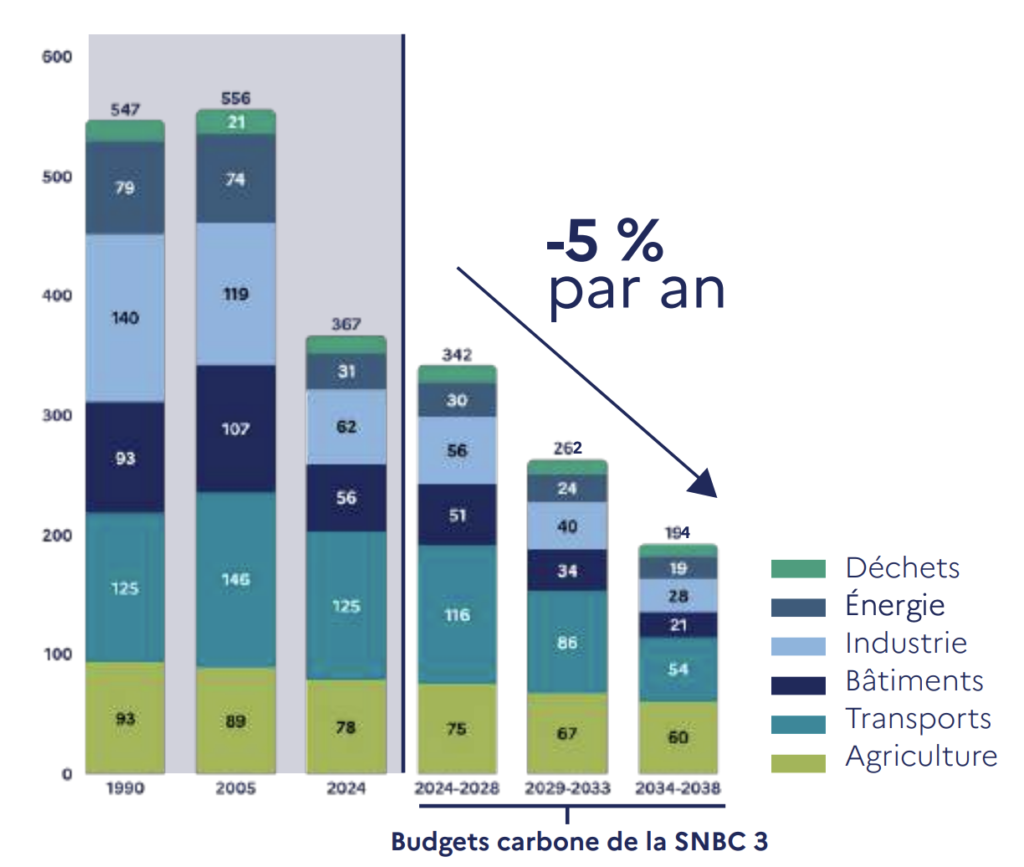
On July 16, France adopted its Third National Low-Carbon Strategy (SNBC 3). This document sets out our country’s path toward carbon neutrality by 2050, with carbon budgets (excluding carbon sinks) revised upward: 347 MtCO2e/year (2024–2028), 265 (2029–2033), and 193 (2034–2038), and a target to reduce gross domestic emissions by a factor of more than 8 compared to 1990 levels. AFEN welcomes this publication and what it represents for the carbon removal sector in France.
How SNBC 3 Is Changing Carbon Removal
The national strategy explicitly incorporates carbon elimination and sets specific targets for it. This represents a significant change from previous versions.
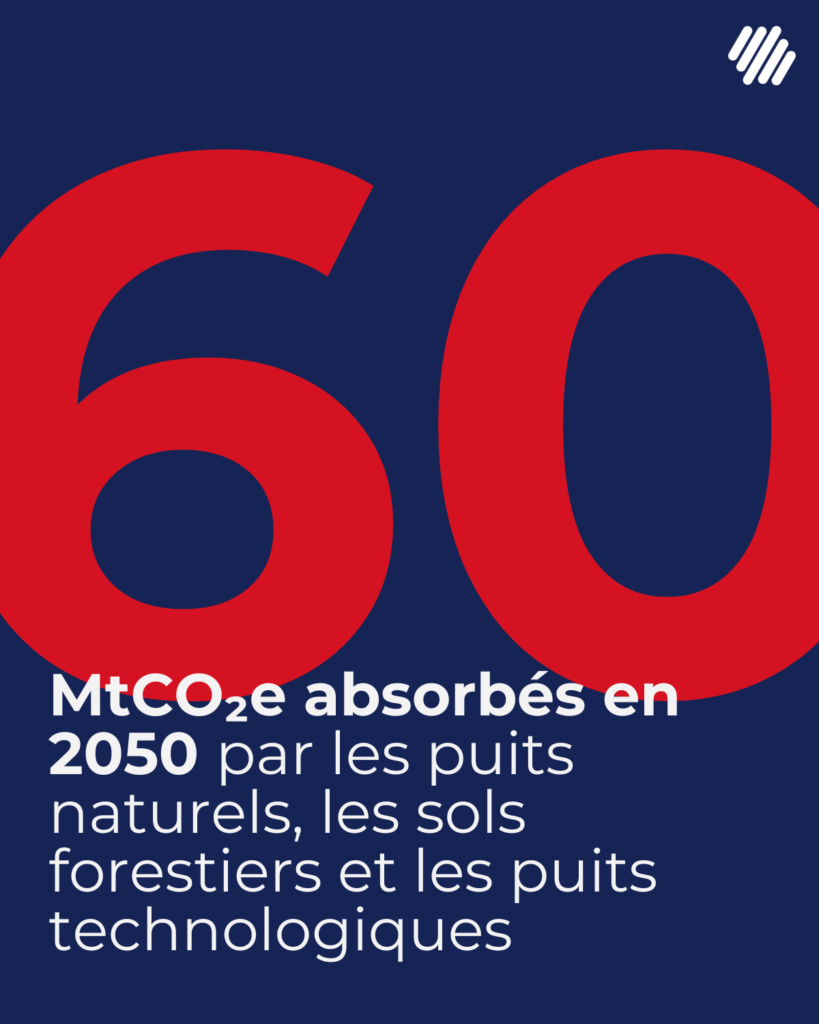
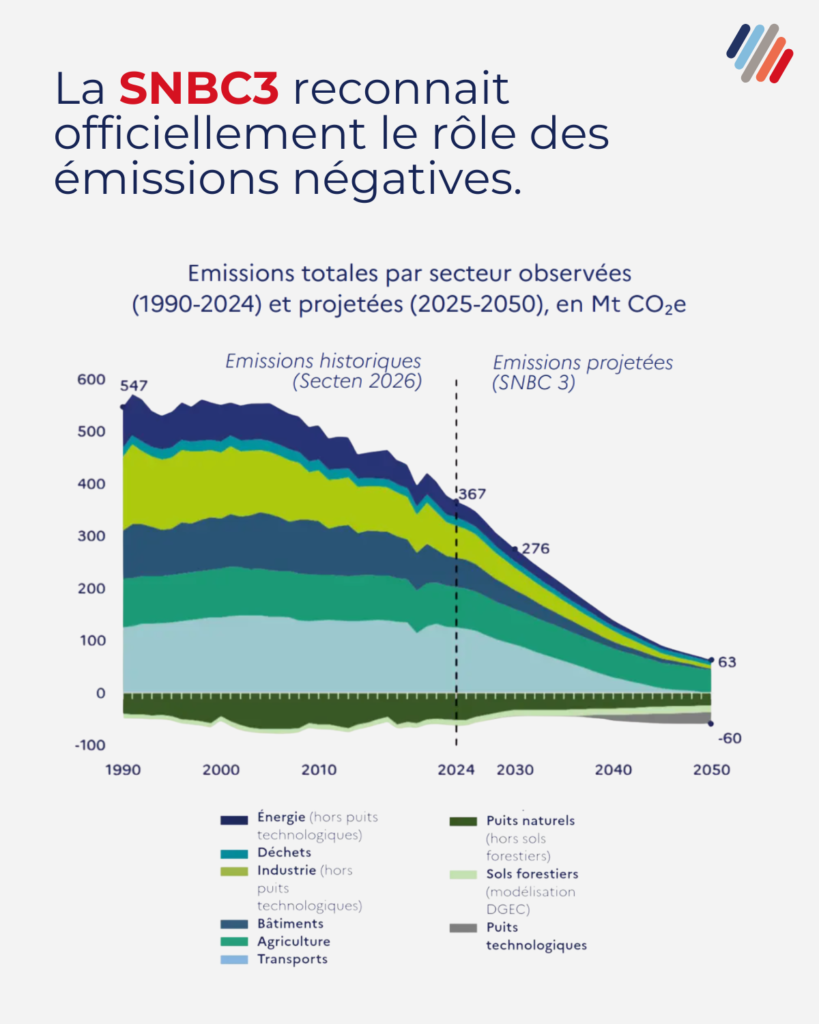
SNBC 3 acknowledges the increasing vulnerability of natural sinks, whose absorption rates are estimated at around 40 MtCO₂e per year by 2050 in the central scenario, with significant variability due to climate uncertainties. It sets order-of-magnitude targets for technological sinks: approximately 15 MtCO₂ per year for biogenic CO₂ capture and 6 MtCO₂ per year for direct air capture by 2050, with intermediate milestones starting in 2030. It also recognizes, for the first time, that these sinks require economic incentive mechanisms to be deployed.
What the High Council for Climate Change Says
In his opinion on SNBC 3, the High Council for Climate Action commends the quality of the document while pointing out a structural shortcoming: the lack of a national strategy dedicated to carbon elimination.
It calls for a more structured approach to pathways, available methods, and the associated conditions for environmental credibility, and makes an explicit recommendation to that effect.
This is a strong signal. It confirms that the question is no longer whether carbon removal is necessary, but how to organize its implementation.
AFEN's Contributions to the Consultation
AFEN actively participated in the consultation process through two successive submissions. In Our Response to the Public Consultation, we made three main requests.
The first concerns the roadmap for natural and technological sinks. SNBC 3 sets target volumes for 2050, but remains vague on the means to achieve them. We call for a dedicated national strategy, developed under the joint authority of the relevant ministries, covering sector-specific milestones for 2030 and 2040, guiding principles for environmental integrity, instruments to stimulate public and private demand, and financing mechanisms tailored to each stage of the sectors’ maturity.
The second focuses on expanding the portfolio of approaches. Beyond biogenic CO₂ capture and direct air capture—the two technological pathways mentioned in SNBC 3—other approaches show strong potential for France: biochar, accelerated rock weathering, mineralization, and regenerative agriculture. Several of these are already covered by delegated acts adopted under the European CRCF Regulation, creating a misalignment with the national trajectory that needs to be corrected.
The third focuses on creating demand. The deployment of low-carbon technologies faces a structural gap between the cost of these technologies and the current carbon price. Targeted policy tools are needed to bridge this gap: carbon contracts for difference, reverse auctions, and institutional public procurement.
A clear signal is also needed for private buyers to correct the imbalance in which reputational risk discourages bona fide participants who are doing exactly what is required.
The Next Step
SNBC 3 sets the course. It marks a real step forward in recognizing carbon removal within French climate policy, a development that the French Association for Negative Emissions (AFEN) welcomes. The next step is to chart a path toward achieving this goal.
This roadmap cannot wait. Technological carbon sinks must increase from less than 0.1 MtCO₂e per year today to nearly 4 MtCO₂e per year by 2038—a fortyfold increase in a single decade—which requires investment decisions to be made now.
AFEN stands ready to assist government authorities in this collective effort by contributing the expertise of its members and its network.
