
Developing an EDC Industry in France: The AFEN White Paper
Homepage » Publications » Developing an EDC Industry in France: The AFEN White Paper
The White Paper from the French Association for Negative Emissions
The next five-year term (2027–2032) will be crucial for achieving France’s climate goals. However, carbon elimination (EDC)—an essential component of any credible path toward carbon neutrality—remains largely absent from the policies that will shape the country’s future.
Now more than ever, it is essential to place it at the heart of the French political agenda. This is because the EDC involves three key challenges: climate, economy, and industrial sovereignty. Without dedicated policies to structure this emerging industry, France will fail to meet its goals and allow other countries to gain the upper hand.
That is why we are publishing an EDC White Paper. Five concrete proposals—which would have a significant ripple effect on private investment—to ensure that France does not miss this opportunity.
Download our white paper and discover our five proposals for embedding carbon elimination into public policy.
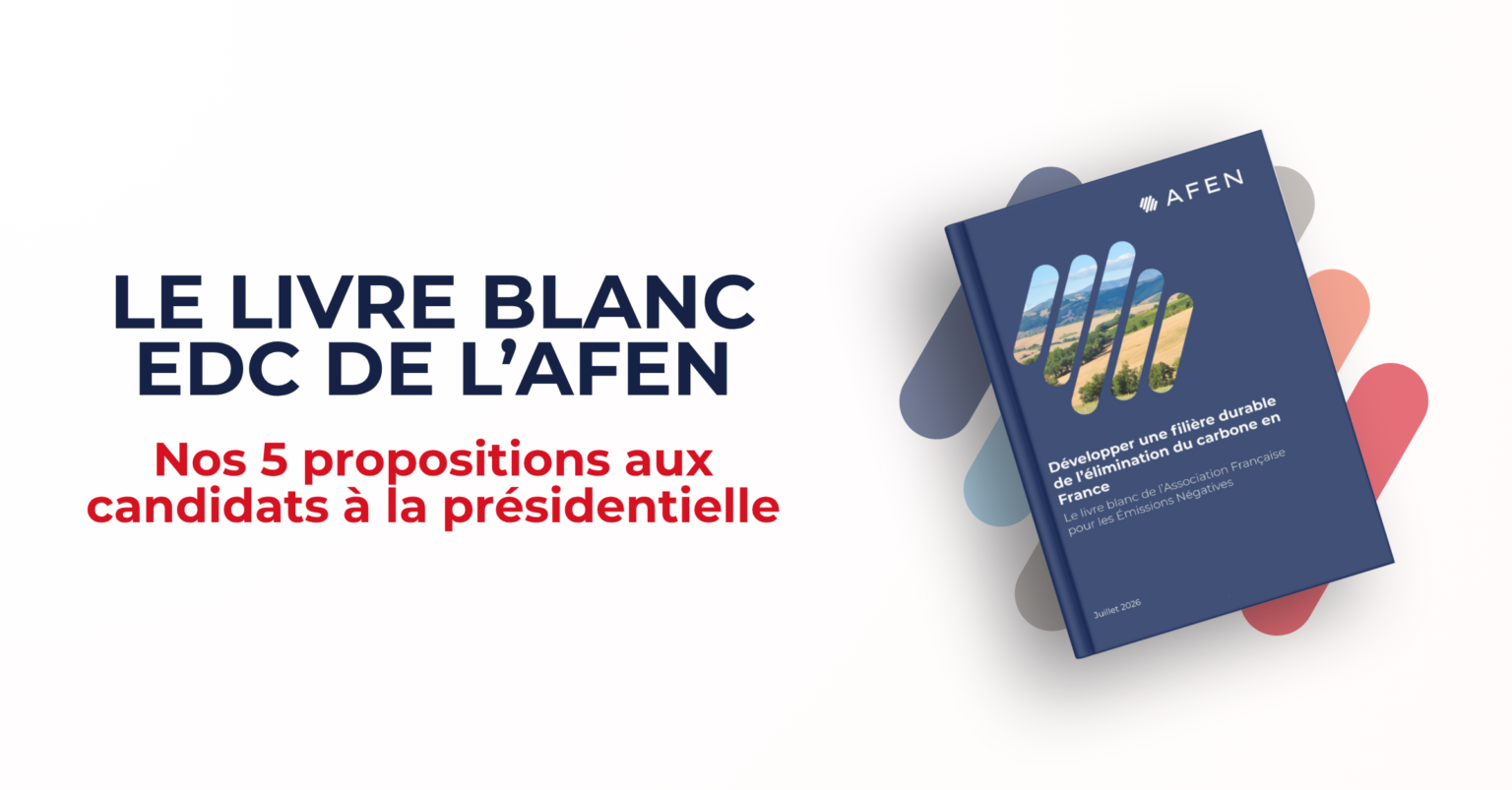
Excerpt
The world is going through a period of uncertainty. Energy security, purchasing power, industrial competitiveness, and defense: these are all issues that dominate public debate and often push climate change to the sidelines. Yet these concerns are interconnected. Dependence on fossil fuels weakens the trade balance, exposes households to price shocks, and keeps France dependent on foreign supplies. Every euro invested in decarbonizing the economy is a euro invested in French sovereignty.
Carbon removal is part of this approach. When it comes to climate change, the science is clear: drastically reducing emissions is essential, but it will not be enough. We must not only offset tomorrow’s residual emissions, but also remove the CO₂ that has already accumulated in the atmosphere over decades. The Intergovernmental Panel on Climate Change (IPCC) estimates that between 5 and 16 billion metric tons of CO₂ will need to be removed annually by 2050 to keep global warming below 1.5 to 2°C. Without this, the goals of the Paris Agreement will be out of reach.
And carbon removal isn’t just about climate change. Developing a carbon sequestration sector in France means strengthening the resilience of farms, making the most of local natural and forest resources, creating new opportunities for industries, and building a sector of excellence with innovative companies and jobs that won’t be outsourced.
France has often been a pioneer in new ideas. It spearheaded the Paris Agreement in 2015 and created the Low-Carbon Label in 2018, one of the world’s first national frameworks for certifying low-carbon projects. But being a pioneer in new ideas is not enough: when it comes to solar power, batteries, and electric vehicles, France—like Europe—has been slow to translate its scientific lead into industrial capacity, allowing nearly 90 % of global production capacity to be concentrated in Asia (IEA, 2024). The risk is that this pattern will repeat itself with carbon elimination: recognizing its necessity without providing the means to prepare for it.
Carbon removal is a new window of opportunity. It is still open—but not for long. The decisions made during this five-year term will determine what will be operational by 2035–2040, a critical period for meeting our climate commitments. This white paper presents five concrete proposals, with significant spillover effects on private investment, to ensure that France does not miss this deadline.
The AFEN Office
Our 5 Proposals for the Presidential Candidates

Proposal 1
Adopt a national carbon elimination strategy.

Proposal 2
Stimulate demand for carbon removal credits.

Proposal 3
Offer financial incentives and guarantee instruments.

Proposal 4
Incorporate carbon removal technologies into an innovation plan.

Proposal 5
Develop CO₂ transportation and storage infrastructure.
AFEN stands ready to work with all program teams to further develop these proposals and facilitate meetings with industry stakeholders.
Do you have a contact on a campaign team? Put us in touch! That’s how the EDC will find its rightful place in every platform.
