
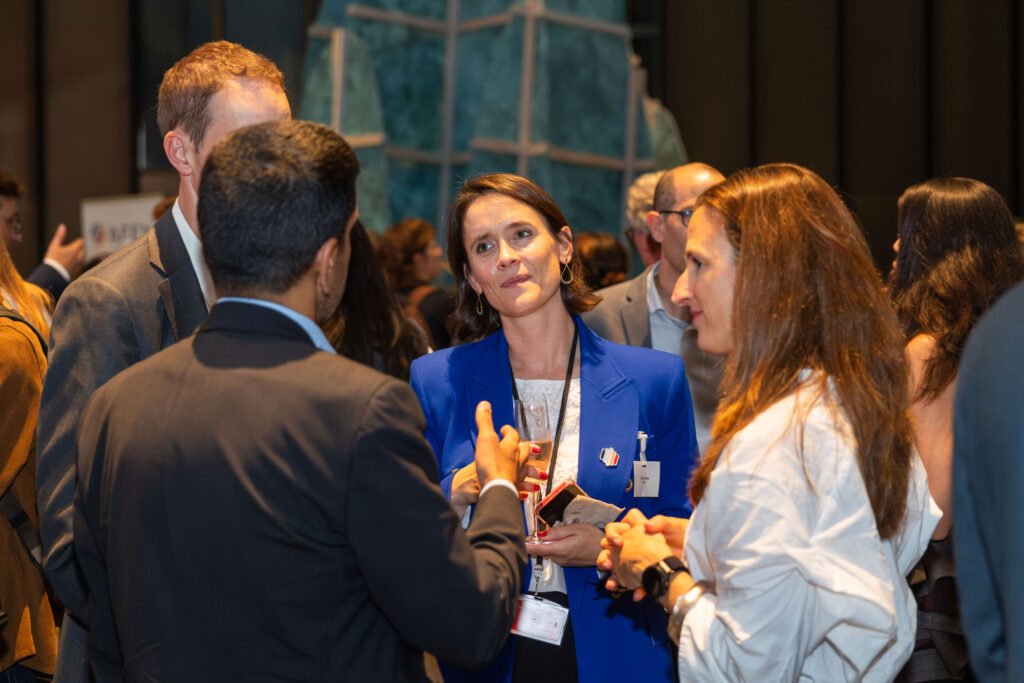
Taking Stock of 2026: that was the goal of the third edition of the CDR Days, which brought together nearly 200 stakeholders—including major corporations, government officials, local authorities, and international experts—in Paris on October 13 and 14.
This edition explored the theme of synergies among all aspects of carbon removal: nature and technology, science and economics, voluntary markets and regulation, startups in the sector, and industry.
2026 proved to be a year of new momentum for the sector, with two main areas of focus:
- A new political impetus, not only at the national level but also within the European Union and across France’s regions.
- New alliances and partnerships, particularly between major corporations and CDR startups.
1. A New Political Momentum, from Paris to Brussels and Across the Regions
At the government level.
« We will not achieve carbon neutrality without significant use of negative emissions. »
Diane Simiu, DGEC (Directorate General for Energy and Climate), gave the discussions a strong boost:
« Net zero is mathematically impossible without relying on carbon sinks. We are implementing national measures, and we need the private sector to make this happen. »
She reiterated that the SNBC3 (low-carbon national strategy) has set a clear course: phasing out coal by 2030, oil by 2040, and fossil fuels by 2050.
« Even so, we need carbon sinks, and the SNBC3 calls for two-thirds natural sinks and one-third technological sinks. »
Even if it meets its decarbonization targets, France is still expected to have approximately 60 million metric tons of residual emissions by 2050. Natural carbon sinks have become less effective, and the SNBC3 acknowledges the need for increased use of technological carbon sinks to offset this shortfall. National targets have therefore been raised to approximately 20 million metric tons of CO₂ removed by technological sinks by 2050, primarily through BECCS and, to a lesser extent, DAC.
At the national level, four major guidelines have been established to encourage projects:
- Development of transportation and storage infrastructure, particularly around Dunkirk and the Grand Ouest region.
- Project Funding. 6 million euros have been allocated to several water collection projects.
- Sustainable use of biomass, with a focus on utilizing available biogenic CO₂, particularly for technologies such as BECCS.
- A focus on certification and quality requirements: France has, in particular, developed the first national public standard, the Low-Carbon Label, which will continue to be developed in coordination with the European CRCF.
At the European level
2026 marked a “historic turning point,” with the European Commission’s proposal to use the EU Emissions Trading System (EU ETS) to finance the purchase of 250 million metric tons of CO₂ permanently removed between 2031 and 2040. This potential high demand would focus on DAC and BECCS technologies and is expected to be confirmed in March 2027.
This strong signal marks a turning point: the CDR is moving from the realm of voluntary participation to that of compliance.
The CRCF regulation is being implemented to standardize and certify the high integrity of projects, with the first delegated acts to be adopted in 2026. The EU Buyers’ Club was launched to support voluntary demand, with the first offtakes expected before the end of 2026, while the proposal to integrate the CDR into the ETS is creating new market dynamics.
At the regional level
Coline Roux, French Association for Negative Emissions (AFEN), presented the AFEN report on decarbonization in the regions, which includes an analysis and mapping of the potential of France’s regions for carbon elimination. The growing importance of concrete local projects was confirmed by several project leaders.
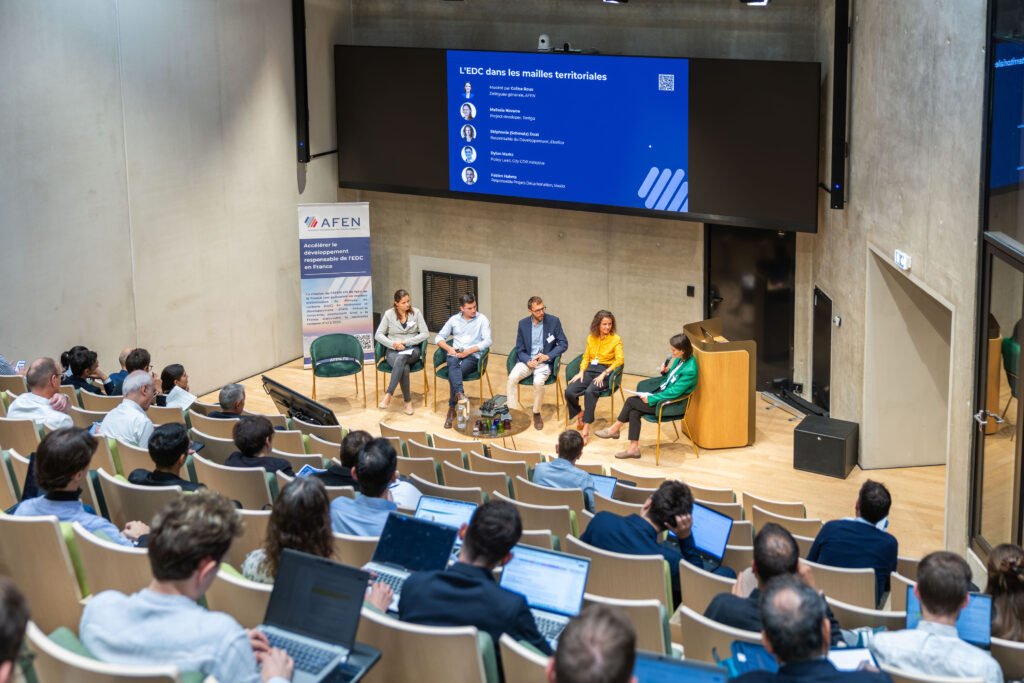
Elodie Le Cadre, Veolia, mentioned several local projects related to waste management, including the one in Le Mans.
« In Le Mans, we sensed that local authorities were genuinely supportive of the project and decarbonization and recognized the associated benefits, such as job creation. »
Mallorie Navarre, Téréga, presented the CCS and BioCCS projects developed around the regional transport and storage of CO₂. The issue of CO₂ sequestration in geological formations is essential and strategic. There is currently no geological storage in France, which results in long supply chains involving the transport of liquefied CO₂ to sites abroad, particularly in the North Sea. This initiative by Téréga is therefore particularly significant.
For Téréga, the success of a project depends first and foremost on early dialogue with all local stakeholders: ADEME, the regional government, mayors, nature parks, and local industries. This dialogue is followed by an administrative approval process and a public consultation.
« Local acceptance of the project and an understanding of its co-benefits are essential. »
In Auvergne-Rhône-Alpes, Stéphanie (Schmutz) Doat, Elodica SCIC , presented an initiative by entrepreneurs organized as a nonprofit cooperative to raise awareness and support businesses in sustainable development. Elodica is supporting an initial project to develop hemp and integrate it into concrete, and has developed a training program on sustainable development for small businesses in the region. What still holds many companies back is primarily the perceived risk of greenwashing, a lack of time to explore the subject, and the perception that action is not required until 2035.
This trend toward local-scale development is confirmed by the City CDR Initiative, which works to engage urban communities in CDR. The organization is already collaborating with Helsinki, Oslo, Tokyo, and San Francisco—and discussions are underway to expand this initiative to France. Dylan Marks, City CDR Initiative, points out:
« Public demand is a key driver. For example, demand for materials that incorporate carbon, such as wood, concrete, etc. »
For France, the recommendation is threefold: integrate CDR into urban strategies, promote public procurement, and consider territorial sovereignty.
How can public authorities further accelerate the growth of CDR at the national and European levels?
A panel of industry stakeholders has identified several particularly effective mechanisms:
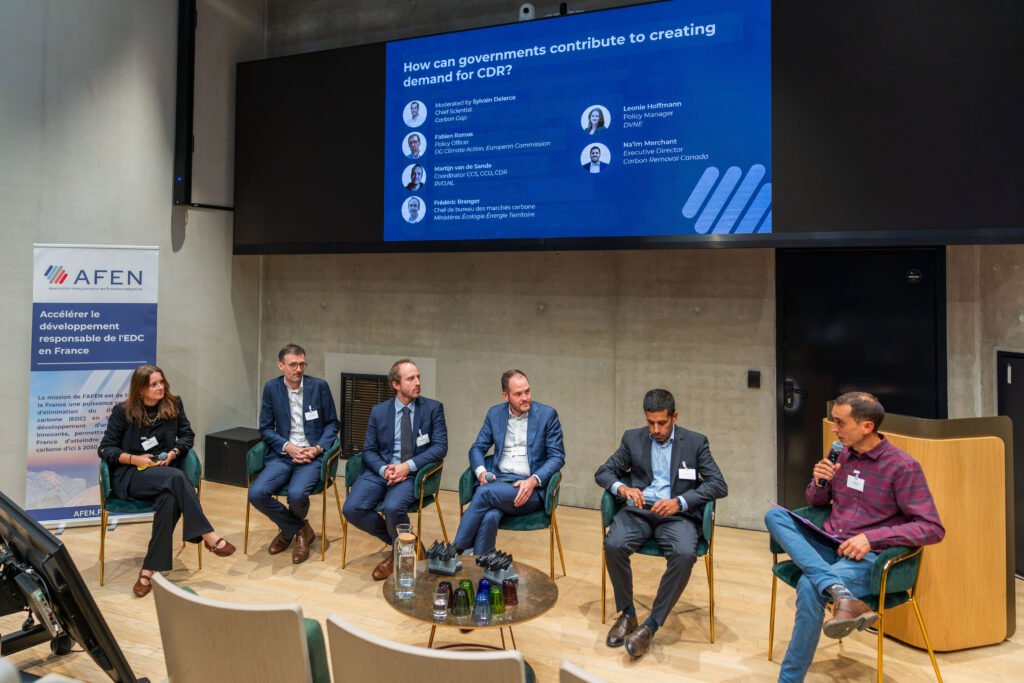
- Reverse auctions implemented in Sweden are a model with great potential, as are contracts for difference (CFDs), which have proven effective in the renewable energy sector.
- In France, The Low-Carbon Label has enabled significant scaling up, with more than 2,000 natural sink projects currently underway (hedges, soils, forests, etc.).
- Companies have a key role to play: by signaling their willingness to purchase carbon credits, they can supplement public funding and send a strong message to governments.
- Communication One challenge remains: the current trend of “greenhushing” is hindering collective action toward net zero and the CDR.
- A portfolio approach should be encouraged. At the European level, the question of expanding the CRCF to include methods other than BECCS and DAC—such as afforestation, storage in agricultural soils, and bio-based building materials—has been raised.
- The European Innovation Council (EIC) has allocated 50 million euros to support carbon removal technologies, across all methods.
The collective dimension necessary for the sector's momentum was highlighted by Na'im Merchant, Carbon Removal Canada:
« Working in the field of carbon removal can be quite isolating. Being able to rely on networks—including industry leaders, government agencies, and organizations—that share a common language provides real support. »
2. New Alliances, New Partnerships
Julie Gosalvez, AFEN, said right from the start:
« CDR is all about partnerships—so we can accelerate together. »
It was the wave of partnerships between major French corporations and CDR startups that perhaps left the strongest impression over these two days
Jan Mertens, ENGIEand Quentin Servais-Laval, Deepsky, presented their partnership—announced in April 2026—which involves the purchase of 15,000 carbon credits as well as a joint research project.
« What made the partnership easier was that ENGIE and Deep Sky share an open approach to different technologies, while ENGIE wanted to evaluate as many pilot projects as possible », confirms Jan Mertens of ENGIE.
Elodie Le Cadre, Veoliaand Fabien Michel, Carborok, have presented a joint project set to begin in late 2026. It is a demonstration project that will enable the mineralization of CO₂ from waste incinerators into construction materials. For Veolia, the waste sector—which accounts for 3 % of France’s emissions—must focus on local decarbonization solutions to avoid transporting waste between municipalities. According to Fabien Michel, Carborok…
« The manufacturer must be able to envision a prototype being scaled up, and the startup must be able to keep pace with development. »
Public funding played a crucial role in mitigating the project’s risks, with support from the BPI, the Pays de la Loire region, and the French government.
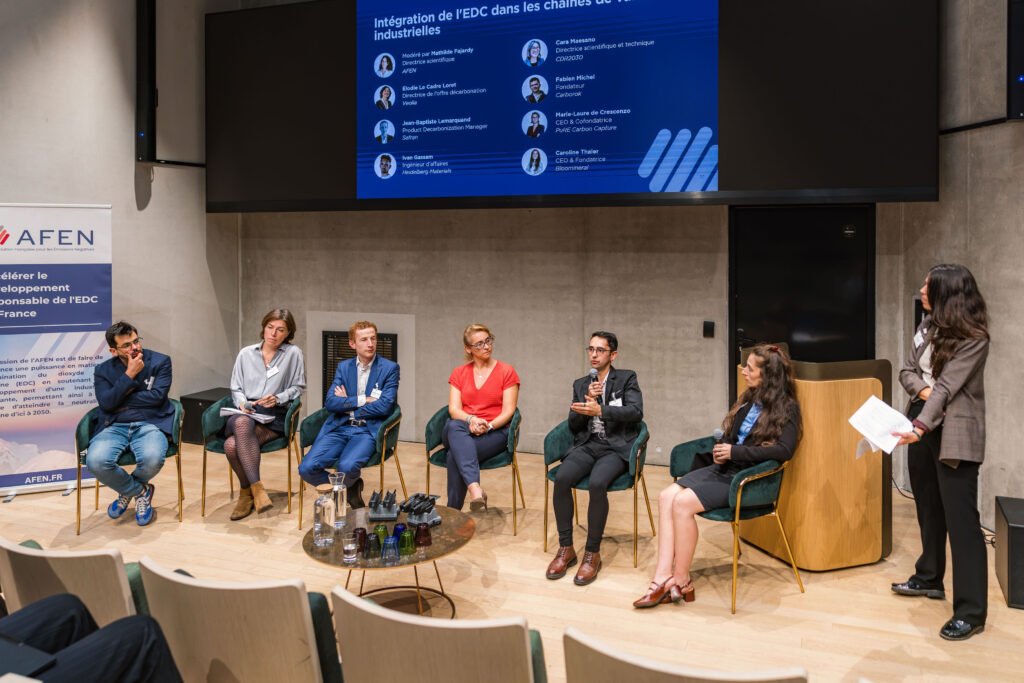
Ivan Gassam, Heidelberg Materials, and Caroline Thaler, Bloomineral, presented their collaboration aimed at decarbonizing cement while maintaining its performance.
Bloomineral captures CO₂ and converts it into minerals using macroalgae. These minerals can replace certain mineral materials currently used in industry. Caroline Thaler, the founder, explains what made it easier for the two teams to come together:
« We are very focused on the material itself and its performance, and we met at trade shows specializing in cement. There was a “fit” on both a personal and academic level. »
« We developed this technology while working as employees of the Safran Group, with access to their network of experts, and the Safran logo opened doors for us. For Safran, it was helpful to adapt its processes to a startup model in order to develop a project very quickly. »
PuRE Carbon Capture is working on the synergy between sustainable fuels and EDC, with Safran acting as a facilitator for scaling up the initiative.
Long-term partnerships with carbon credit buyers
For ENGIE, as for many other companies, Version 2.0 of the SBTi’s Corporate Net-Zero Standard has brought the issue of residual emissions much closer to the forefront.
Published in June 2026, this standard now formally and mandatorily incorporates carbon removal: starting in 2035, large companies will be required to offset an increasing portion of their residual emissions through removal credits. What was previously a voluntary and distant goal is now a clear requirement for signatory companies, which are encouraged to begin planning their procurement strategies now.
« 2035 is just around the corner », says Anne Idiart of ENGIE.
The portfolio approach—aimed at de-risking the strategy—is clearly evident among buyers. Google seeks to balance short-term effectiveness with long-term sustainability. A few months ago, the American company launched an R&D challenge to encourage the development of various projects.
Several companies are seeking partnerships that go beyond simply purchasing carbon credits. To Léo Barruol, Schneider Electric, The teams are exploring new industries and technologies to see how the company, as a solutions provider, can support these projects.
« Take control of your schedule and budgets »": According to large companies, there are real benefits to entering the CDR market today.
According to these major companies, there are real benefits to entering the CDR market today. For TD Bank Canada, this involves securing future needs and conducting rigorous due diligence without rushing. At ENGIE, this approach was preceded by a lengthy exploration of the ecosystem, conducted calmly and without pressure—an advantage for both the company and its customers.
Vincent Poncet, Google, explains:
« Buying in bulk early on has given us greater access to and visibility of the market. We know that the required quantities aren't available, so our purchases help support the industry. »
A Necessary Partnership with Banks and Investors
Although 2026 was a challenging year for climate-related activities—and a difficult one for investors—French EDC startups secured partnerships and funding to scale up their operations.
Fabienne Moimaux, BNP Paribas, emphasized the importance of predictability.
« A project attracts capital when its risk-adjusted cash flows become sufficiently predictable. »
BNP Paribas engages with various stakeholders across the CDR and CCS (carbon capture and storage) value chain. The group offers bankability studies prior to the final investment decision (FID) and is a partner in large-scale projects such as Chestnut Carbon. For projects under 25 million euros, which are more difficult to finance individually, pooling resources could help achieve the critical mass needed to attract investors.
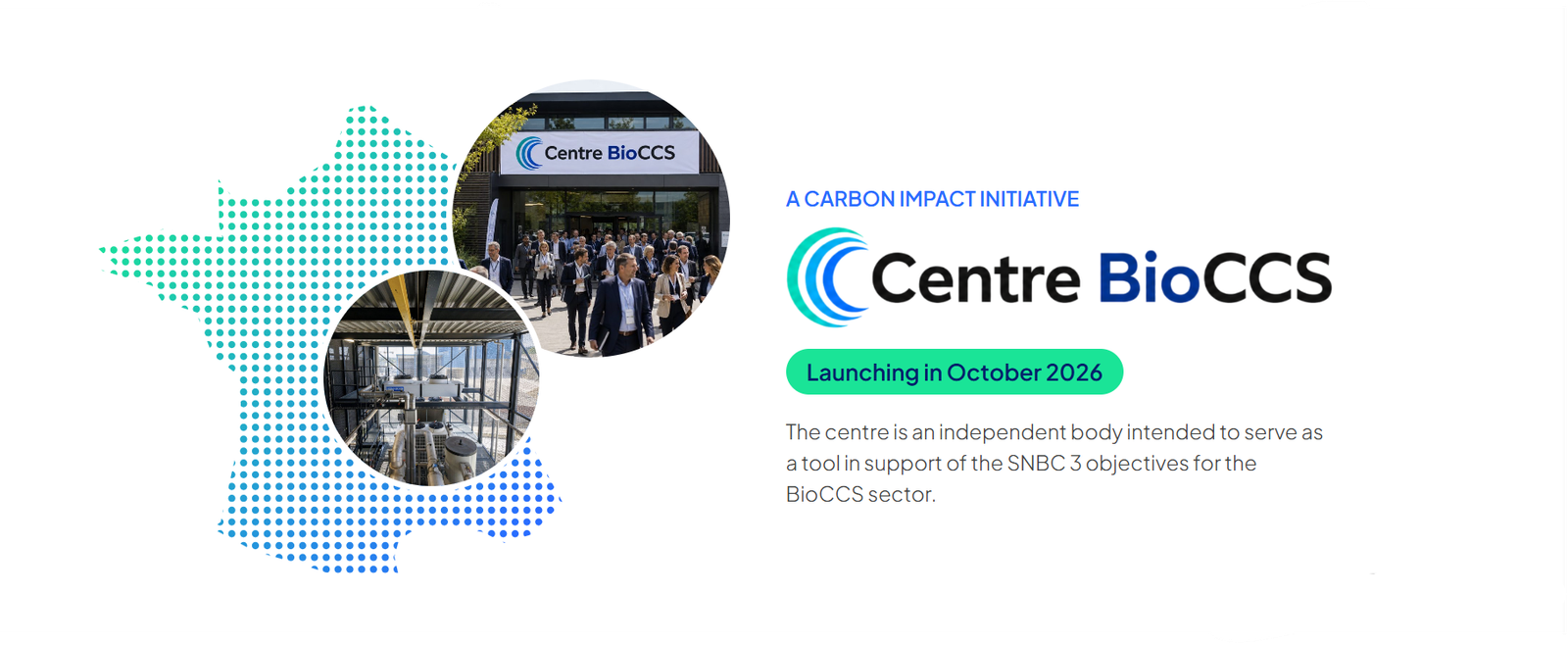
The conference marked the launch of a new initiative aimed at fostering new partnerships: the BioCCS Center, launched on October 14
« BioCCS is gaining ground around the world, but not in France. We took the initiative to launch a roadmap to outline how we can scale up from 0 to 16 Mt—the SNBC3 target. »
announced Karim Rahmani, Carbon Impact France, which provided the impetus for this new organization. The Center is an independent organization designed to serve the objectives of the SNBC3 for the BioCCS sector. It seeks to bring together emitters of biogenic CO₂, credit buyers, technology providers, and stakeholders in the industrial and energy sectors.
Finally, numerous experts—from BCG to the SBTi—also presented their work and analyses, which will be the subject of a separate AFEN article.
AFEN itself has posted three resources online that are available to everyone:
In conclusion, Coline Roux, AFEN, returned to the theme of synergies and partnerships that was central to these meetings. Alliances are a driving force in accelerating the development of this sector, which is strategic for carbon neutrality.
Her last words?
« It takes a village—and the more this village grows, the more we represent the ecosystem and the more influence we have to advance the industry and help France and its companies achieve carbon neutrality by 2050. »
