
On May 20 and 21, AFEN was in Brussels for the CRCF Days, a two-day event organized by the European Commission focusing on carbon removal—technological approaches (Day 1) and nature-based solutions (Day 2).
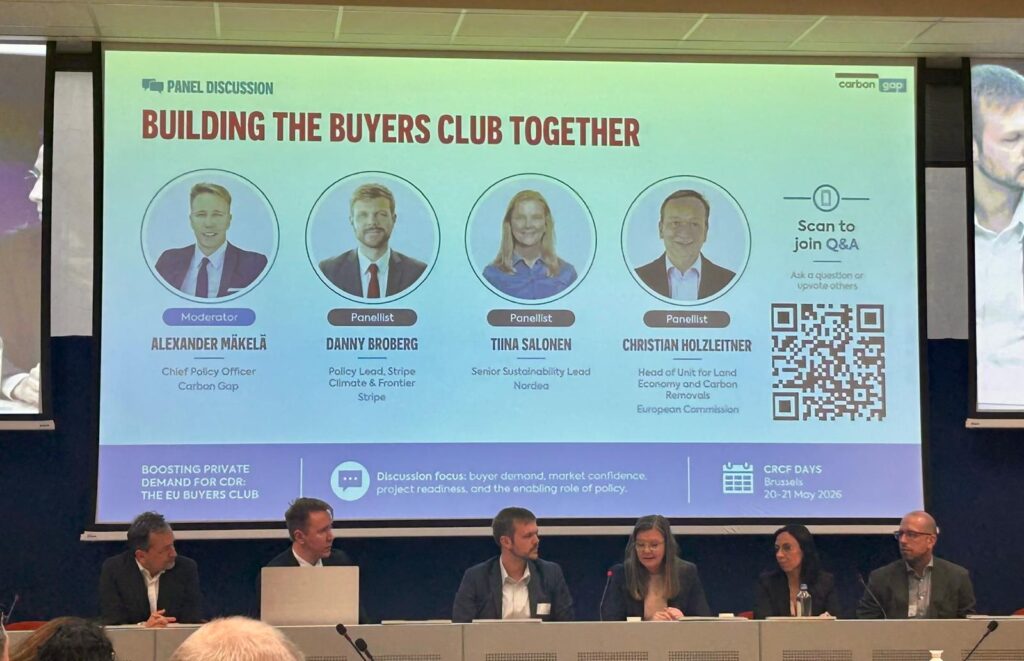
The event provided an opportunity to unveil the details of the’EU Buyers’ Club (the European Union’s buyer consortium), a key voluntary initiative aimed at stimulating demand and private investment in certified removal credits.
As a reminder: the CRCF Regulations (Carbon Removal and Carbon Farming), adopted in late 2025, is the single certification framework at the European level. It covers three main categories of activities:
- Permanent carbon removal: including biomass with carbon capture and storage (BECCS), direct air carbon capture (DACCS), and biochar (BCR) (finalized methodologies).
- Carbon sequestration and reduction through carbon farming: carbon sequestration in agricultural soils, agroforestry, wetland restoration, and afforestation (methodologies currently being adopted).
- Storage in sustainable products: including wood-based building materials (methodologies expected by the end of 2026).
Engaging buyers: the voluntary market as a stepping stone to compliance
The immediate challenge is to engage both experienced buyers and intermediaries, combining their capital with European and national public funding. But to achieve this, a paradigm shift is necessary.
The voluntary market needs to scale up
To date, the voluntary market has driven—and continues to drive—carbon removal. The signed contract recently between BioCirc and Microsoft The fact that it costs 650,000 credits is further proof of this.
However, an industry cannot be built around just a few tech giants. The EDC critically needs a robust, diverse, and proactive market with a much broader base of participants than it has today. As was rightly pointed out Johan Börje (Stockholm Exergi) :
«How can we get the thousands of companies with SBTi targets to want to join this club?»
Compliance markets are on the horizon (but there’s no time to waste)
It’s no longer a question of «if,» but of «how»: the Commission confirmed that it was actively reviewing the incorporation of permanent delistings into the European compliance market (EU ETS).
However, this regulatory shift will not take place before 2030. The Commission itself acknowledges that it is impossible to wait until then: in order to get off the ground, these projects urgently need capital and demand signals starting today.
A strategic opportunity: plan ahead to avoid being caught off guard
As pointed out Danny Broberg (Stripe) :
«It’s clear that the future lies in integration into compliance markets, and the buyer’s club allows companies to get a foot in the door.»
For businesses, joining the EU Buyers’ Club is a major business and risk management opportunity. It is a way to build their capabilities and refine their decarbonization strategies before the use of these credits becomes mandatory or heavily regulated. By positioning themselves now, buyers secure privileged access to high-quality CRCF-certified credits, protect themselves against future price volatility, and turn future regulatory constraints into a clear competitive advantage.
The Structure of the EU Buyers’ Club: Key Takeaways
- Open governance: an initiative led by buyers and facilitated by the Commission. The lack of strict entry criteria is intended to maximize potential demand and attract a wide range of stakeholders.
- Different paths: separate paths for permanent removals and for the carbon farming, in order to adapt to the specific needs of buyers and the various uses of loans.
- An ambitious goal for 2026: Europe wants to see concrete results as early as 2026. The goal is to trigger multiple final investment decisions (FIDs) for permanent removals (via five carbon credit purchase agreements for projects financed by the EU Innovation Fund) and to sign the first carbon credit purchase agreements carbon farming (with a clear model for value redistribution throughout the chain).
Key points still being defined:
- ❓ Use cases and requirements (claims) : Buyers have a critical need for clarity. The Commission is working on guidelines to establish what claims companies can legitimately make.
- ❓ Catalytic public funding: exploration of a «EU Purchasing Facility» (European Purchase Facility) funded by the European Competitiveness Fund to mitigate the risks associated with private investment. The terms and timeline have yet to be determined.
- ❓ Portfolio diversification: The focus is currently on projects supported by the’EU Innovation Fund (primarily large-scale BECCS). While these volumes are vital, stimulating voluntary demand for a broader range of removal approaches will be crucial.
AFEN's Appeal
📢 To buyers: Don’t wait for the compliance markets. Join the EU Buyers’ Club today to stay ahead of the curve, secure your supply, and build your expertise!
🤝 To the community: Let’s break down the silos. Technological and nature-based solutions remain too siloed (there was very little overlap among participants between Day 1 and Day 2). Yet all forms of carbon removal are essential to achieving carbon neutrality. It is time to bridge these divides.
At the’AFEN, we work closely with project leaders across the entire carbon removal spectrum to make this interdisciplinary collaboration a reality.
