
The Essentials
The carbon market is evolving rapidly. Based on a study by the Carbon Business Council and discussions with European buyers, AFEN has identified six key trends shaping demand and, for each one, a potential solution.
- A new generation of buyers is facing the same obstacles: a difficult business case to build, risk aversion, and fears of greenwashing. The solution lies in robust contracts, regulatory clarity, and education.
- Understanding of carbon removal (CR) remains limited in a fragmented standards landscape, hence the need for shared guidelines and quality benchmarks.
- EDC has been postponed to «later,» after the direct cuts. However, it takes years for a high-quality offering to gain traction: getting involved early helps bring it to life.
- Buyers are waiting for the rules to stabilize, but two developments are already changing the landscape: the SBTi V2.0 standard and the announced reform of the EU ETS.
- Price and delivery are the top priorities; nature-based solutions are attractive because of their cost. However, a diversified portfolio spreads risk and anticipates future price rebalancing.
- EDC is more readily adopted when it extends the company's core business.
The key issue is also the timeline. Taking action today means having greater control tomorrow and contributing to a market that, without it, might fall short.
The carbon market is evolving rapidly. That is why AFEN sought to better understand the motivations and barriers faced by carbon buyers today. For our analysis, we drew on two sources: a new study by the Carbon Business Council, based on a survey of 25 sustainability managers in the United Kingdom, France, Germany, and the United States, on the one hand, and discussions held by The Climate Agency and AFEN with several European buyers and industry stakeholders, on the other.
For each observation, we combine buyers’ feedback with concrete suggestions for addressing it. Feel free to comment, contribute, or share your perspective.
1. A new generation of buyers is emerging, but it faces the same obstacles
Sophie Gallois, CEO of The Climate Agency, notes: «Increasingly, budgets are being transferred from sustainability teams to finance departments, procurement departments, or sometimes to facility management teams.«
Regardless of the decision-maker’s role (CSR, finance, or procurement), one challenge keeps coming up: developing an internal business case to justify the investment, in a context where standards, frameworks, and regulations are constantly changing.
This has several consequences: a greater focus on price and delivery dates, a more pronounced aversion to risk, and a need for education.
A European market intermediary comments: «The new generation of buyers isn’t really looking to make catalytic investments. They want to buy credits, and they want to receive credits. They’re also less comfortable with the idea that projects might carry a high risk of failure or non-delivery.»
The risk of greenwashing is also emerging as a major obstacle, particularly for European and British companies.
Two concerns overlap. The first stems from the memory of past controversies in the voluntary market: projects that overestimated their emissions reductions, and credits that failed to deliver on their promises. Since then, the market has become more structured, integrity standards have been strengthened, and measurable and verifiable emission reduction credits offer more robust guarantees.
The second concern relates to communication: what can a company say publicly about its purchasing practices? In Europe, although the future of the Green Claims Directive remains uncertain, the Empowering Consumers Directive, which takes effect in September 2026, restricts environmental claims, particularly claims of carbon neutrality based on offsetting. Added to this is uncertainty regarding the treatment of credits under the Corporate Sustainability Reporting Directive (CSRD), for which reporting will begin in 2027 for the vast majority of affected companies.
«This isn't just a theoretical risk,» says one buyer.
These risks are real but manageable: robust contracts and protective clauses on the market side, regulatory clarification on the policy side, and active education on the buyer side.
2. Awareness and understanding of carbon removal (CR) remain limited
A spokesperson for the Carbon Business Council puts it very bluntly: «On a scale of one to ten, I’d say our understanding is around a four or five. We have a general idea of the subject, but not a real understanding of the differences between avoidance and removal, or of verification standards.»
A specialist in carbon credit trading confirms this: «There are perhaps 35,000 companies worldwide that have already purchased a carbon credit—including avoidance credits, offset credits, etc. Then, perhaps 10,000 are committed to the SBTi. Another 3,000 have purchased credits related to nature-based solutions. Perhaps 1,000 are involved in some way with biochar. And perhaps 200 are involved in BECCS or other more technology-based solutions.»
Beyond these figures, a structural factor contributes to this lack of understanding: the fragmentation of the landscape. Standards, frameworks, and methodologies are proliferating, with no universally recognized quality benchmark. For a buyer, it becomes difficult to know what to rely on. Helping buyers requires practical guides, comparative analysis tools, and shared quality benchmarks that enable them to navigate this landscape.
3. A Focus on the Short Term
Many companies view EDC as an important issue, but not an immediate priority. In their climate roadmaps, sustainable carbon removal comes later, once direct reductions are already well underway. The challenge for EDC is to move it from the “To Explore for the Future” list to operational and budgeted plans.
As one respondent put it: «We see the EDC as something that will be relevant later in our SBTi journey, once we’ve already made significant progress on our direct reductions. It’s not yet a short-term priority.»
Many companies find it difficult to develop detailed plans beyond three to five years.
«Our plans are based on what exists today. The real challenge is figuring out what new technologies will emerge—and at what cost. That’s why we don’t go into too much detail about the period between 2030 and 2040: too much will have changed by then.»
These are valid points. In terms of climate priorities, carbon removal complements an ambitious and robust decarbonization strategy; it is never a substitute for it.
But the way the market is taking shape is challenging the tendency to wait. A high-quality waste disposal solution cannot be rolled out overnight: it takes years to move from a pilot project to industrial-scale operations. This solution must therefore be developed now, even before demand fully materializes.
This is an aspect of the business case that is often overlooked. If companies expect a high-quality offering to be available tomorrow, committing to it today (through demand signals, pre-purchases, and advance purchase agreements) helps ensure that this offering will be available when needed. Companies that commit today do more than just help create the supply: they gain practical experience, build relationships of trust with project developers, and develop a deep understanding of the supply chains—all of which will give them a decisive advantage when EDC becomes indispensable.
4. A wait-and-see approach until the rules are confirmed
In Europe, regulatory uncertainty is weighing on purchasing decisions. Several frameworks are intertwined: the CSRD, the future Empowering Consumers Directive, the Green Claims Directive (currently on hold), and the European Carbon Removal Certification Framework (CRCF), which is still being developed for operational implementation. More broadly, the SBTi and future frameworks for recognizing credits are shaping how companies approach EDC.
The perceived risk is that credits purchased today might not be recognized as expected in the future.
As one respondent put it: «We’d prefer to wait until the legislation is clearer before we really commit. It’s too risky to build a strategy around a framework that’s still taking shape.»
Until regulations are fully established, the SBTi occupies a unique position and plays a very important role, both in Europe and elsewhere. For many companies, it is the framework that defines the issue: When will an EDC be required? For which residual emissions? And to what standard?
On June 11, 2026, the SBTi published, Version 2.0 of its Net-Zero standard. Carbon removal is now formally incorporated into the plan, with a specific trajectory: Starting in 2035, large and medium-sized companies in high-income countries will be required to offset a portion of their emissions using carbon credits, beginning at approximately 1 % and increasing to 100 % by the year of carbon neutrality.
By recognizing the role of EDC from the very beginning of companies’ climate trajectories—rather than only at the end—the new standard sends a strong message: carbon removal is not a last-resort option, but a tool to be integrated alongside an ambitious decarbonization strategy. For companies, this is a call to action—there’s no time to wait.
A potentially game-changing development: the recently announced reform of the Emissions Trading System (EU ETS) now includes carbon removal credits for companies subject to the system. If confirmed, carbon removal would no longer be merely a voluntary initiative and a demonstration of climate leadership, but a full-fledged regulatory requirement for companies subject to the ETS. What was once a signal to plan ahead is now becoming a necessity to prepare.
5. Price and delivery are the key factors driving demand
One respondent sums it up: «The total cost compared to other options matters a great deal. Not because the quality or validity of the credits don’t matter. But in a voluntary context, price becomes a major factor.»
In the context described above, nature-based solutions are very appealing. They are often less expensive, well understood and accepted, and offer rich opportunities for communication.
An expert interviewed by The Climate Agency put it this way:
«The scientist on the sustainability team may have a very good understanding of the most sustainable EDC. But the procurement department or the CFO looks at the price difference and asks: Why buy, for example, BECCS at 300 euros per metric ton when I can purchase nature-based solutions at one-tenth the price and fulfill part of my obligations?»
For many buyers, a diversified portfolio is not yet a short-term priority. Yet it is a powerful tool: it spreads risk, combines different levels of permanence and co-benefits, and supports the emergence of the solutions that tomorrow’s carbon neutrality will require. The new SBTi rules underscore this: the most persistent emissions will need to be offset by removals of equivalent permanence. Valuable nature-based solutions alone will not be able to cover everything.
A rebalancing of prices is also expected: technological solutions, which are currently expensive, are likely to see their prices drop significantly as they scale up to industrial levels, while nature-based solutions could see their prices rise due to growing climate risks that threaten their sustainability. Building a diversified portfolio today also means positioning yourself for the future
6. The connection to the company's business remains crucial
In the process of purchasing carbon credits, the connection to the company's own operations often makes all the difference.
«Where am I making an impact? Can I take action in the same geographic area? Can I do something within my own value chain?»
In this context, nature-based solutions are appealing. For certain industries—such as the insurance sector, which is affected by flood risks, or the agri-food sector—a new perspective is emerging that views nature as infrastructure supporting the value chain.
«Nature is suddenly seen as infrastructure. Especially when you’re funding projects that strengthen the resilience of your supply chain or your assets.»
This logic applies not only to nature. Depending on the sector, technology-based ESD approaches fit just as naturally into the value chain.
Mineralization is the most direct example of this: a cement plant can permanently sequester CO₂ in building materials—a process that is integral to its operations when the carbon is of biogenic or atmospheric origin. In France, several sites are already working toward this goal.
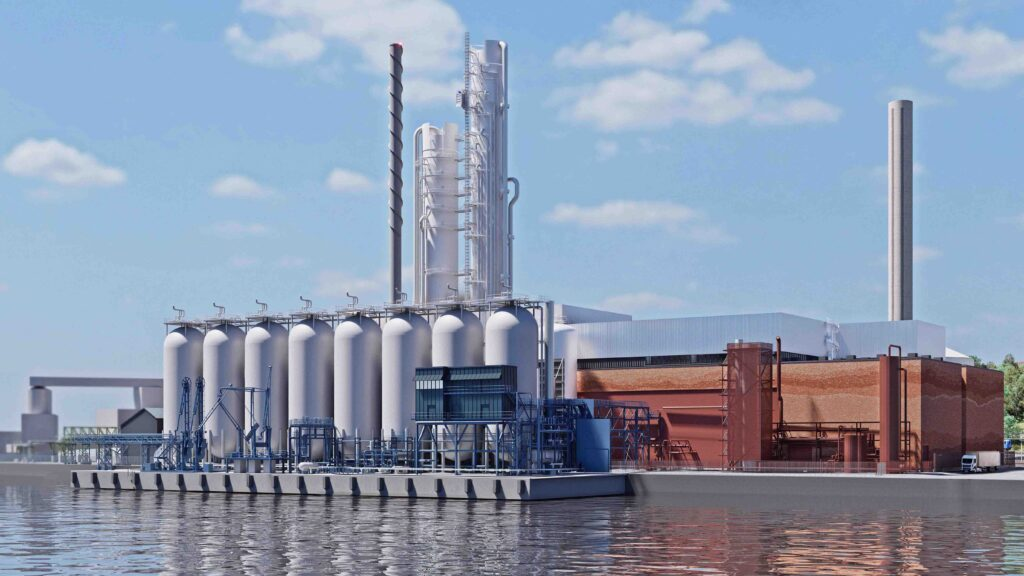
Biocarbon follows the same logic. Biomass-based approaches (biochar, BECCS) are particularly relevant for green gas producers, but also for the paper industry and agriculture, which have this resource on-site. Waste treatment industries also have a role to play: they handle large volumes of biomass and organic waste that, rather than being incinerated or landfilled, can feed biochar production facilities or energy recovery plants with carbon capture—a way to transform a waste stream into a carbon sink.
Biochar also opens up industrial applications beyond carbon sequestration alone. The Stellantis Group is exploring its integration into certain automotive components, a sign that biogenic carbon can find a second life in the industrial value chain.
The principle is the same as for nature-based solutions: the most compelling corporate social responsibility (CSR) initiative is often the one that extends the company’s core business, rather than one that is added from the outside.
In conclusion: the real issue is the timeline
For most companies, EDC will eventually become part of the solution for emissions they cannot eliminate entirely. But that will come later—when the decarbonization of their value chain is further along, and when there is greater clarity on policies, standards, and methodologies. The real challenge is timing. Investing today means having greater control tomorrow and helping to shape a market that, without such efforts, might not exist when we need it most.
France has a unique portfolio of solutions: soils, forests, biochar, mineralization, BECCS, DAC, and other carbon removal approaches. The challenge, therefore, is not to pit these solutions against one another, but to build a market capable of financing multiple forms of carbon removal, each with different levels of maturity, permanence, cost, and co-benefits.
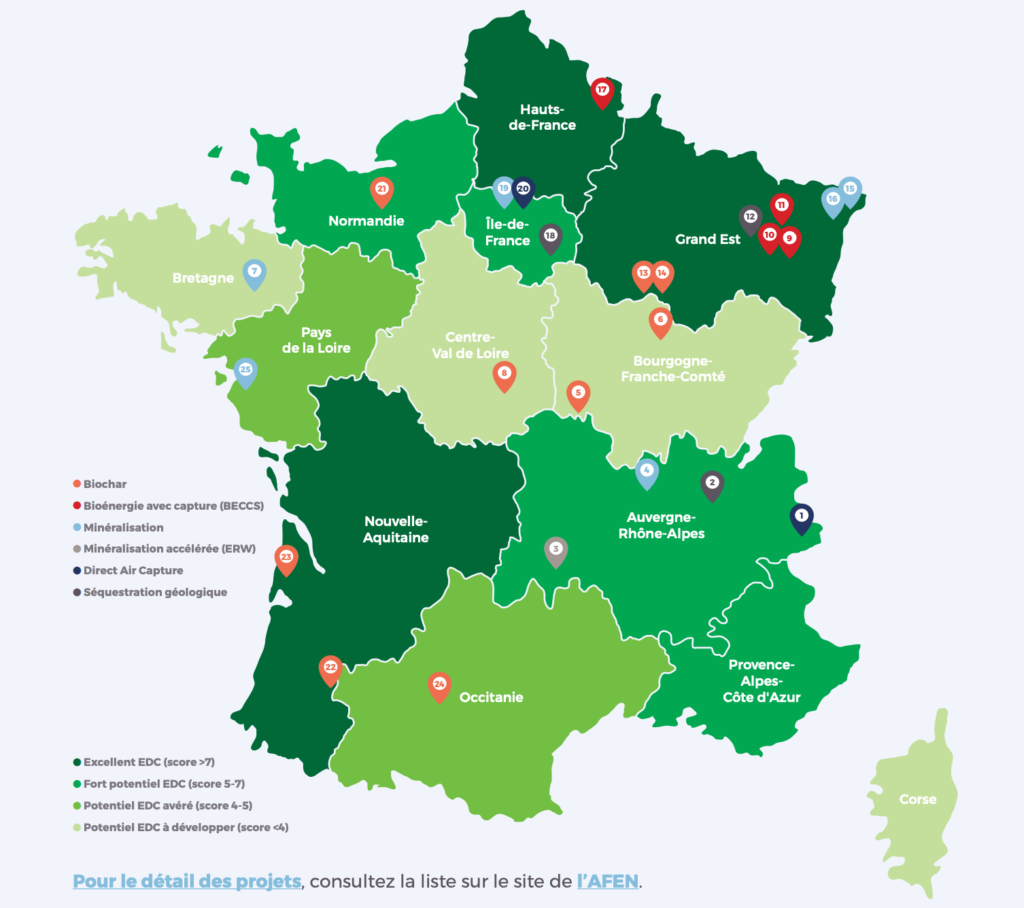
«Major French companies are beginning to get involved in this sector. Airbus, BCG, and Schneider Electric have already purchased sustainable removal credits; ENGIE has just signed an agreement with Deep Sky (DAC) that includes the purchase of carbon credits,» says Coline Roux, Executive Director of AFEN. «We’re also noticing, at our EDC conferences, a growing presence of CAC 40 companies. In France, nature-based solutions often enjoy more immediate acceptance. One of the challenges is to raise awareness of high-permanence solutions, which are an important component of a balanced portfolio.»
Navigating shifting standards, cost trade-offs, and requirements for continuous availability is no easy task. This is precisely where an organization that helps shape the industry has a role to play: clarifying, providing the necessary tools, and connecting people. In France, this is one of AFEN’s core missions: to help companies turn an issue that’s still perceived as distant into a concrete path forward.
