
According to Carbon Gap, “Understanding and Implementing the Like-for-Like Principle”, 2025
In brief
To halt climate change for good, it is not enough to achieve carbon neutrality just once: we need sustainable carbon neutrality, where carbon flows are rebalanced and major carbon sinks are stabilized.
The Like-for-Like (LfL) principle, or source-sink equivalence principle, establishes a minimum standard for offsetting emissions that are difficult to reduce, known as residual emissions:
- Fossil CO₂ can only be neutralized through permanent carbon removal (CCS).
- Biogenic emissions require robust biogenic EDC (agriculture, land, etc.).
By establishing these rules, the equivalence principle strengthens the incentive to reduce emissions before offsetting them and clarifies the appropriate uses of temporary and permanent removal approaches.
In the short term, however, its implementation faces structural constraints: a still-limited supply and the high cost of permanent EDC, as well as the need to create demand for biogenic EDC.
AFEN’s position on this issue is clear: reduce emissions first, and begin establishing responsible governance now to scale up robust carbon removal solutions.
1. Why the equivalence principle (or “like-for-like”)?
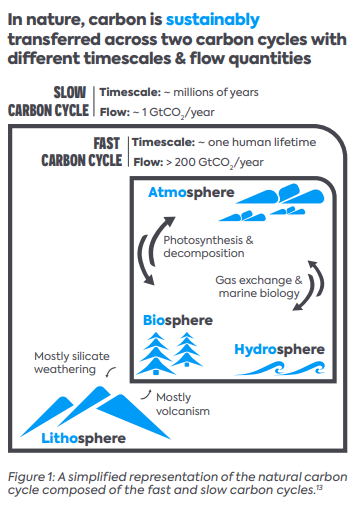
Carbon neutrality is everywhere, but it’s not always credible. It is possible to claim “carbon neutrality” while continuing to shift highly stable fossil carbon (slow cycle, lithosphere) to more vulnerable reservoirs (forests, soils, oceans) that can burn, dry out, or become saturated (Bern, 1999 ; Dooley et al., 2024).
The Carbon Gap report offers a simple guide to avoiding these precarious trajectories: aiming not only for carbon neutrality, but for ”sustainable carbon neutrality,” where carbon flows are rebalanced between fast and slow cycles and where the main carbon sinks stabilize (Fankhauser et al., 2022 ; IPCC, 2018).
2. The principle of equivalence in practice
The principle of equivalence reflects this requirement in the use of CO₂ offsets:
Voluntary Residual fossil fuel emissions should be offset only through permanent carbon capture, returning carbon to very long-term sinks (geological storage, certain mineral deposits, and the most sustainable biochar).
Voluntary Residual biogenic emissions should be offset by biogenic EDC (forests, soils, biomass) provided that the risk of spillage is controlled.
Short-lived greenhouse gases such as methane (CH₄) require specific rules: priority reductions, as well as, where appropriate, “stacked” temporary removals to offset their peak warming potential (Harmsen et al., 2020 ; Lynch et al., 2020).
The principle of equivalence applies only to offsetting. It does not call into question “contribution”-based approaches or the role of protecting natural sinks, but clarifies what constitutes robust, long-term offsetting (Allen et al., 2022).
3. What the principle of equivalence actually changes
Three major trips:
- Discounts first, really. Fossil fuel emissions must first be reduced as much as possible, and only then offset as a last resort through permanent removals. Removals do not replace reductions; they address the residual emissions. The fact that permanent EDC is still expensive today (average price ~320 $/tCO₂ for sustainable, CDR.fyi) and limited in volume only reinforces this logic.
- Biogenic EDC is finding its true purpose. They are moving away from the “low-cost fossil fuel offset” approach to focus on residual biogenic emissions (agriculture, LULUCF, waste), which already account for several GtCO₂e per year and whose relative share is set to increase.
- The need for permanent EDC is becoming clear. The EU still expects 400–550 MtCO₂e/year of residual emissions in 2050, from all sources, of which 129–256 MtCO₂e are to be offset by permanent removals (ESABCC, 2025). Today, truly sustainable removals amount to hundreds of thousands of tons (Smith et al., 2024). The gap is structural.
4. Challenges and Opportunities for the EU
Carbon Gap identifies four main barriers:
Office Hours : Draw a clear line between permanent and temporary EDC.
Offer : Slow ramp-up of the permanent EDC, falling short of projected needs.
Price : potentially large cost difference between permanent and biogenic EDCs (Allied Offsets, 2025).
Accounting : targets and inventories that combine emissions reductions, passive natural sinks, and carbon removal, which perpetuates fungibility and complicates the application of the equivalence principle (Lamb et al., 2024).
Proposed measures for the EU:
Set separate targets reduction and disposal, and then, within disposal, separate targets for biogenic and permanent disposal (Carbon Gap, 2025: “Divide to Deliver”).
Reforming accounting by distinguishing between natural passive sinks and carbon removals associated with human activities in inventories, with specific treatment of land use, land-use change, and forestry (LULUCF) (Allen et al., 2024 ; ESABCC, 2025). Passive natural sinks cannot be counted as removals as defined by the IPCC (Intergovernmental Panel on Climate Change), which reserves this concept for anthropogenic activities (IPCC, AR6 Synthesis Report, Annex I: Glossary, 2023).
Create a request for all disposal methods by implementing a price on biogenic emissions, supporting the scaling up of permanent EDC through research and innovation (R&I) funding, encouraging public procurement, and integrating them into the Clean Industrial Deal and the Net-Zero Industry Act (European Commission, 2024–2025).
Implement the principle of equivalence gradually with an increasing compliance rate, a structured grace period, and a hybrid approach combining requirements and indicative targets.
5. AFEN’s Position
For AFEN, this report confirms that:
- Reducing emissions remains the top priority, but CO₂ removal is essential to achieving sustainable carbon neutrality.
- The equivalence principle (or “like-for-like” principle) provides a simple integrity test: which emissions are offset, through what type of offset, and for how long.
- France and the EU must work together to promote the development of robust biogenic waste treatment and permanent disposal, by clarifying their respective roles in both public policy and corporate strategies.
An essential compass, but a challenge to put into practice
While the principle of equivalence serves as an indispensable guide for ensuring scientific integrity and the sustainability of carbon neutrality, its practical application still requires time to reach operational maturity. The transition from theory to practice is indeed hampered by complex economic realities, particularly the cost of and access to permanent removal technologies, as well as the imperative to scale up demand and funding for nature-based solutions. The challenge in the coming years will therefore not be to question the relevance of the concept, but rather to collaboratively develop viable transition pathways for all stakeholders.
